Mad Skills Motocross 3
- 4.2
- Rating
- 50.00M
- Installs
- Free
- Price

 Analysis by App-foxy
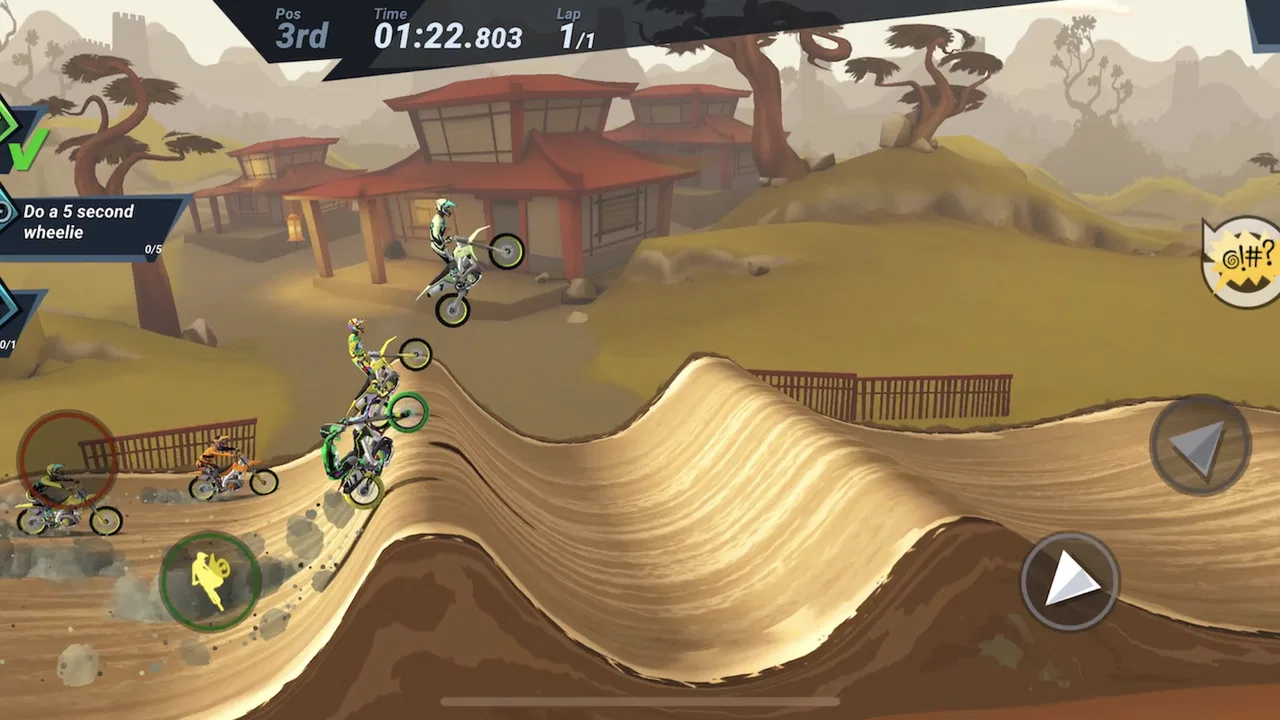
I spent time with Mad Skills Motocross 3 as a quick-play racing game, and my first impression was that it understands why motocross works so well on a phone. A race can fit into a short break, yet the bike still demands attention from the moment the gate drops. The tracks are built around speed, jumps, landings, and timing rather than long menus or a complicated simulation setup. I can pick it up for one attempt, then find myself replaying the same section because my landing was almost right.
That balance makes it an appealing choice for anyone who wants off-road motorcycle racing without committing to a lengthy session. It is free to download, aimed at Everyone, and developed by Turborilla. The game has reached over 50 million installs and holds a 4.2 average from around 111 thousand ratings, which fits my experience: it is easy to understand immediately, but becoming consistently fast takes patience.
How I approach a normal race session
My usual workflow is simple. I start with a few races to read the track rather than trying to win on the first attempt. The important information arrives quickly: where the bike leaves the ground, which jumps need a controlled landing, and whether a corner rewards an early input or a late correction. Once I know that rhythm, I stop treating the course as a single sprint and divide it into small sections.
You May Also Like

 Blood Strike: 2.5 Anniversary
Blood Strike’s Loadouts Turn Every Drop Into a Tactical Gamble
A close look at Blood Strike’s custom loadouts: how fast access to signature weapons reshapes its battle royale rhythm, rewards preparation, and narrows the gap between fights.

 Pandora - Music & Podcasts
Pandora’s Music Is Easy to Start, but Harder to Recover
Pandora’s strength is its low-effort path from a seed to a station. Its weak spot is how much confidence it asks you to place in connection, setup, and quiet recovery.

 8 Ball Pool
 Is Built on Rivalries, Rematches, and Routine
A close look at the rivalries, rematches, shared routines, and unanswered safety questions that turn a quick pool match into a persistent mobile community.

 Samsung Music
’s Quiet Strength Is Playing What You Already Own
Its reach comes less from spectacle than from dependable access to a personal library. That simplicity is both the app’s strongest retention engine and its ceiling.

 AccuWeather: Weather Radar
AccuWeather Review: A Quick, Clear Forecast for Everyday Decisions
For everyday plans, the best forecast is the one you can understand quickly. AccuWeather makes rain timing, radar, and local conditions easy to act on, with a few trade-offs.

 Hill Climb Racing
Why Hill Climb Racing Still Turns Crashes Into One More Run
A tiny car, a bumpy hill and one more upgrade: Hill Climb Racing keeps resurfacing because its simple chaos makes every near-miss feel personal.
More From Our News Desk



That change in mindset is the first useful lesson. A mistake near the finish is not always caused by the final jump. It may begin several obstacles earlier, when I carried too much speed, landed with the bike tilted, or used a correction that made the next jump awkward. I get better results when I identify the first moment the run went wrong instead of simply restarting and repeating the entire race without a plan.
The controls are approachable, but the game is not mindless. Steering and bike movement have to work together, especially in the air. I often use a short first attempt to learn how much rotation is needed for a particular jump. After that, I focus less on reacting and more on preparing the bike before it leaves the ramp. This makes the controls feel more deliberate and gives each replay a clear purpose.
A realistic everyday use case is a short commute or a few minutes waiting for an appointment. I can complete a handful of attempts without needing to remember a large story or manage a complicated team. The downside is that the same convenience can expose the game’s demanding side: if I only have the patience for one casual race, a difficult section may feel more frustrating than entertaining.
The game is at its best when I accept repetition as part of the design. I do not expect every run to improve my result. Some attempts teach me the correct speed for a jump, others show that I am entering a corner badly, and a few are simply poor runs. Treating those failures as information keeps the experience satisfying. Players who want immediate, effortless victories may find the retry loop tiring.
Settings I check before chasing better times
I recommend checking the available control and display options before judging the handling. Small changes in how the game responds can affect whether the bike feels precise or slippery, particularly on a phone with a smaller screen. I prefer a setup that lets me see the bike clearly and make short, repeatable inputs rather than dramatic movements. The best arrangement is the one I can reproduce under pressure.
I also pay attention to comfort. Racing games can tempt me to hold the phone tightly, but that makes fine corrections less consistent over time. A relaxed grip helps when a run requires several small adjustments in succession. If the screen feels crowded by my fingers, I reposition my hands before blaming the track. That is a practical distinction: a control layout that works in a quick test may become uncomfortable during repeated attempts.
Sound is worth considering as well. I like having enough audio feedback to recognize the rhythm of a run, but I do not rely on sound alone. In a noisy place, the visual movement of the bike and track remains more important. For quiet play, headphones can make the session more immersive, although the game’s core challenge still comes from timing and position rather than from audio cues.
Because this is a free game with in-app purchases ranging from $0.49 to $99.99 per item, I would decide in advance how I want to handle optional spending. I can enjoy the racing without treating every obstacle as a reason to buy something, but the presence of purchase options means it is sensible to keep a personal limit. That is especially important for younger players, even though the content rating is Everyone.
The current version is 4.10.1, and the game runs on Android 7.0 or later. That makes it accessible to many older devices, but compatibility does not guarantee identical comfort on every phone. Screen size, touch response, and general performance can change how easy it is to make precise corrections. If the bike feels inconsistent, I first check whether the issue is my input or the device before forming a strong opinion about the handling.
Patterns that make repeated attempts faster
Experienced play is less about frantic reactions and more about building repeatable patterns. I try to enter each jump with a known intention: maintain a stable line, prepare a rotation, or sacrifice a little speed for a safer landing. This prevents me from making a different decision every time. A reliable slower section can be more valuable than a spectacular shortcut that only works occasionally.
One of my favorite habits is to focus on landings before worrying about maximum speed. A clean landing preserves control for the next obstacle, while a fast but unstable landing often creates a chain of corrections. Once I can land consistently, I gradually push the approach speed. This gives me a useful progression from survival to improvement instead of turning every attempt into a gamble.
Another practical technique is to repeat a section immediately after a mistake while the cause is still fresh. If I wait too long, I may remember only that the run failed, not whether I entered too high, rotated too far, or corrected too late. I use the next attempt to change one thing. Changing several inputs at once makes it difficult to learn which adjustment actually helped.
Shortcuts and faster lines should be treated as tools, not obligations. When I discover a route that looks quicker, I test it across several attempts. A line that saves time but demands a perfect landing may be worse for my overall results than a slightly longer route I can execute repeatedly. This is one of the game’s more interesting trade-offs: the fastest-looking path is not always the fastest path for a real player.
I also avoid restarting too quickly. A damaged run can still reveal useful information about the rest of a course. Finishing it lets me learn the sequence of later jumps, which reduces the mental load when I eventually arrive there in a strong attempt. Restarting is valuable when I already understand the section; continuing is better when I am still mapping the track.
For players competing against friends, this approach matters even more. A personal best is not just a test of reflexes; it is a record of which decisions can be reproduced. I would rather build a stable run and then improve one weak section than chase a dramatic result that depends on luck. The racing remains competitive, but the improvement process feels closer to practice than to random trial and error.
Where the game’s depth starts to show its limits
Mad Skills Motocross 3 offers more depth than its simple pick-up-and-play structure suggests, but it is still a focused mobile racer. Its appeal comes from mastering track flow and bike control, not from presenting a broad motorsport management experience. Players looking for detailed vehicle tuning, a large simulation layer, or a long narrative campaign should set expectations accordingly and consider a different type of racing game.
The same focused design can become repetitive. The first attempts on a course are exciting because I am discovering its rhythm. Later attempts depend on whether I enjoy refining small details. If I do, the repetition is rewarding. If I want constant new scenery, extensive exploration, or a changing objective every few minutes, the narrow emphasis on racing technique may feel restrictive.
There is also a difference between being accessible and being forgiving. The game is easy to start, but a player who wants polished results must learn its timing. A casual rider can enjoy the sensation of jumping and racing without mastering every section, yet the competitive side asks for more discipline. That split is useful to understand before installing it: the opening is friendly, while the higher level of play is deliberately demanding.
Free access is another trade-off. Being able to begin without paying is convenient, especially for someone unsure whether this style of racing suits them. At the same time, optional purchases can affect how each player experiences progression and temptation. I recommend treating the free version as a complete trial of the driving itself and judging the game on whether the core races are enjoyable before considering any purchase.
I would skip it if my main priority were realistic motorcycle physics, relaxed scenic driving, or a controller-first experience. I would also hesitate to recommend it to someone who dislikes repeating a jump many times to improve a result. On the other hand, it is a strong match for players who enjoy short competitive challenges, precise touch controls, and the satisfaction of turning a failed landing into a clean one.
Compared with more conventional circuit racers, this game puts much more emphasis on vertical movement and recovery. There is no need to memorize a traditional lap in the same way; the important question is how the bike behaves across uneven terrain and airborne sections. Compared with arcade racers built around drifting or power-ups, it feels more personal and mechanical. My own input is usually the reason a run succeeds or fails, which makes improvement feel earned but also leaves less room for casual button-mashing.
Who gets the most from the racing format
I think the best audience is someone who likes measurable improvement but does not always have time for a long session. The short-race structure makes it easy to practice one weak point, put the phone away, and return later. It also suits players who enjoy friendly competition without needing a large multiplayer commitment. A friend’s result can give a run a purpose, while the individual practice remains useful even when nobody else is playing.
It works for newcomers because the basic idea is immediately clear: keep the bike moving, handle the terrain, and reach the finish cleanly. It also has enough precision to hold the attention of experienced arcade racers. The important qualification is patience. The game rewards a player who observes patterns and repeats a successful input, not someone who expects the first attempt to reveal the entire skill ceiling.
Parents may appreciate the Everyone rating, but I would still keep an eye on purchase settings when children use the device. The racing itself is easy to understand, while the optional spending range makes household boundaries sensible. For adults, the same advice applies in a different way: decide whether purchases add value to your own experience, rather than buying simply because a difficult section interrupted a good run.
If you are wondering whether a newer or older phone is suitable, the Android requirement begins at version 7.0, so the software threshold is not especially demanding by modern standards. The more relevant question is whether your device gives you a comfortable, responsive screen. Precision racing exposes touch delay and awkward hand placement more than a turn-based game would.
If you are wondering whether it is worth trying without spending money, I would say yes, provided you enjoy the core loop during the first practice sessions. Free entry lets you find out whether the handling feels natural to you. I would not make a purchase decision based on the promise of avoiding frustration; the central challenge is still learning the track and improving execution.
My verdict after learning its rhythm
Mad Skills Motocross 3 succeeds because it makes motocross feel immediate without removing the need for skill. I can start a race quickly, understand what went wrong, and try again with a specific adjustment. The strongest part is not simply the speed; it is the way a small improvement, such as a cleaner landing or a more controlled approach, can transform an entire run.
Turborilla has created a racing game that is easy to recommend to friends who enjoy compact challenges and repeatable mastery. Its 4.10.1 release, broad Android compatibility from 7.0 onward, free price, and Everyone rating make it approachable, while the substantial player base shows how widely the format has traveled. Still, popularity does not remove the need for honest expectations: this is a focused motocross game, not a full motorcycle simulator.
My advice is to begin with a comfortable control setup, learn each track in sections, and change only one habit after a failed attempt. Test faster lines over several runs instead of trusting a single lucky result, and finish unfamiliar races before restarting them automatically. The most rewarding way to play is to treat every retry as practice with a purpose.
I would install it for short sessions, friendly score chasing, and the satisfaction of gradually making difficult terrain look easy. I would choose another racing game if I wanted deep customization, realistic touring, or a calmer experience. For everyone in between, this is a lively off-road racer with a clear identity, useful depth, and just enough friction to make a clean finish feel genuinely earned.
FAQs for Mad Skills Motocross 3
01What are the key features of Mad Skills Motocross 3?
Mad Skills Motocross 3 offers an immersive motocross experience with realistic physics, stunning graphics, and a wide range of customizable bikes. The game includes a variety of tracks and challenges, multiplayer mode, and frequent updates with new content. Players can enjoy competitive racing with friends or against AI opponents.
02Is Mad Skills Motocross 3 free to play?
Mad Skills Motocross 3 is available as a free download with optional in-app purchases. While the base game provides plenty of content for free, players can purchase additional features, such as bike upgrades or cosmetic items, to enhance their gaming experience. This allows for a balanced gameplay experience for both free and paying users.
03What devices are compatible with Mad Skills Motocross 3?
Mad Skills Motocross 3 is compatible with most modern Android and iOS devices. It requires a stable internet connection for multiplayer features and regular updates. Users should ensure their device meets the minimum system requirements for optimal gameplay performance, including sufficient storage and up-to-date operating systems.
04How does the multiplayer mode work in Mad Skills Motocross 3?
The multiplayer mode in Mad Skills Motocross 3 allows players to compete against friends or other players worldwide. Users can join races, participate in tournaments, and climb global leaderboards. This feature enhances the competitive aspect of the game, providing endless replayability and a platform to showcase racing skills.
05Are there regular updates and new content in Mad Skills Motocross 3?
Yes, the developers of Mad Skills Motocross 3 frequently release updates that include new tracks, bikes, and features. This commitment to regular updates ensures a fresh and exciting experience for players. Users can expect seasonal events and limited-time challenges that keep the gameplay dynamic and engaging.
Pros
- Smooth and responsive controls.
- Stunning graphics and animations.
- Regular updates with new content.
- Challenging and varied tracks.
- Multiplayer mode for competitive play.
Cons
- Requires constant internet connection.
- In-app purchases can be costly.
- Battery drains quickly during play.
- Advertisements can be intrusive.
- Limited customization options.

Mad Skills Motocross 3
Gallery